Amazon / Health & Fitness / BENEFITS OF CUCUMBER
REVIEW
Benefits of Cucumber is a free app about exactly one vegetable.
A health-reference app with the narrowest topic on the Amazon Appstore — and an editorial honesty most wellness apps could learn from.
BY THE APP COMRADE DESK · MAY 11, 2026 · 3 MIN READ

Benefits of Cucumber
MANEESH
OUR SCORE
5.5
AMAZON
★ 5.0
PRICE
Free

The Amazon Appstore’s Health & Fitness category contains a small genre of apps that no other store really has: the single-ingredient reference app. Benefits of Cucumber is one of these. It is free, it is about cucumbers, and it is exactly as deep as that sentence makes it sound.
There is something refreshing about the directness. A user opens it knowing what they are getting. There is no fitness coach to dismiss, no subscription prompt, no onboarding survey asking for their height and weight. The app is a digital pamphlet about a vegetable, served straight.
Whether that is worth the storage space depends entirely on how much one already knows about cucumbers, and how much they trust a free indie app from a developer credited only as “Maneesh” to fill in the gaps.
It promises one thing and delivers that one thing. Most wellness apps cannot say the same.
FEATURES
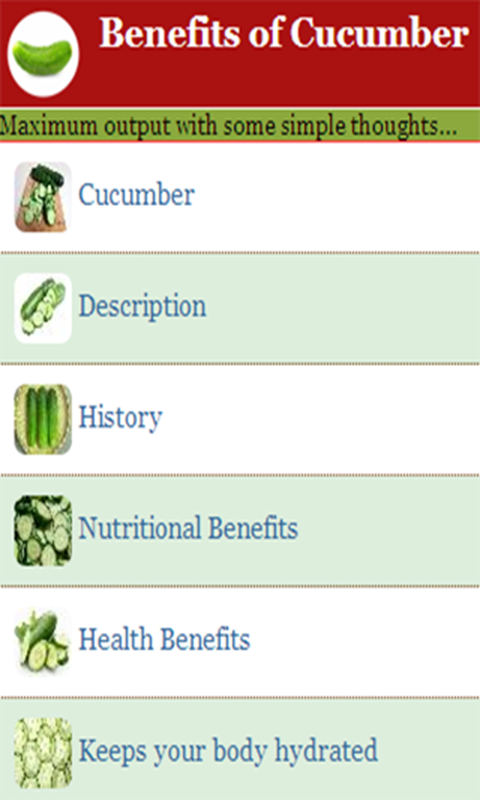
Benefits of Cucumber is exactly what its title says: a static reference app dedicated to the health properties of a single vegetable. It is free, runs on Fire tablets and Fire TV, contains no in-app purchases, and ships from an independent developer credited only as "Maneesh." The content surface is a short scrollable list of bullet points covering hydration, skin care, weight management, digestive effects, and the usual roster of vitamins and antioxidants cucumbers contain.
There is no calculator, no daily reminder, no recipe layer, no community feed. The app does not track anything. It does not ask for an account. It is closer in form to a one-page printable pamphlet than to a modern wellness app, and it is upfront about that scope from the title onward.
Screenshots show a plain off-white layout with banner imagery and unformatted body text. The category is Health & Fitness on the Amazon Appstore, where it sits among hundreds of similarly narrow single-topic reference apps — Benefits of Honey, Benefits of Ginger, Benefits of Green Tea — most from the same handful of indie publishers working a long-tail SEO strategy on the Appstore search index.
MISSION ACCOMPLISHED
The honesty of the framing is the genuine win. Most health apps oversell — a step tracker rebrands as "wellness coaching," a recipe app calls itself a "nutrition ecosystem." This one says it is about cucumber, and then it is about cucumber. There is no upsell, no subscription wall, no synthetic engagement loop trying to convert a five-minute read into a daily habit.
For the Fire tablet audience — often older readers, often using the device as a kitchen-counter reference — that directness has real value. Tap the icon, get the information, close the app. The transaction is complete and nothing is asking for your email address.
ROOM TO IMPROVE
The information itself is thin and unsourced. Claims about cucumber's effects on blood pressure or skin hydration appear as plain bullet points with no citation, no dosage context, and no acknowledgement that the underlying nutritional research is generally modest. A reference app earns trust by showing its work; this one does not.
Design is the second gap. The screenshots reveal default system fonts, no dark mode, no accessibility considerations beyond what the OS provides, and imagery that looks pulled from a free stock library. A reader with low vision or who reads in landscape will not have a good time. Five minutes of typographic care would meaningfully raise the floor.
CONCLUSION
Benefits of Cucumber is the kind of free Amazon Fire app that exists because the Appstore long tail rewards specificity. It will not change anyone's diet, but it will not waste anyone's time or money either. Install it if cucumber genuinely interests you. Skip it if you want a real nutrition reference — and look at a sourced database like the USDA's FoodData Central instead.