Amazon / Games / ANGRY BIRDS 2
REVIEW
Angry Birds 2 is a slingshot wrapped in a slot machine.
A decade after launch and one Sega acquisition later, the sequel to the defining mobile game of the 2010s is still fun for ten minutes and exhausting for everything after.
BY THE APP COMRADE DESK · MAY 10, 2026 · 4 MIN READ

Angry Birds 2
ROVIO ENTERTAINMENT OY
OUR SCORE
5.5
AMAZON
★ 3.8
PRICE
Free

Angry Birds 2 was released in 2015 as the first free-to-play entry in the franchise that had defined paid mobile gaming for half a decade. The reaction at the time was loud and not flattering. Eleven years, one Sega acquisition, and one $200 million impairment write-down later, the design philosophy has not budged — if anything, the screws have been tightened.
What is unusual is that the underlying game is still good. The slingshot physics are the most refined Rovio has ever shipped. The bird-card mechanic adds a small but real tactical layer. The art holds up. None of this is the problem.
The problem is everything Rovio has built on top of it. A five-life energy cap. A gacha wheel for boosters. A premium subscription pitch that surfaces every other session. An Amazon Appstore build that performs better than most ports here, used to deliver one of the most aggressively monetised free-to-play structures in the category. The bones are great. The cage around them is not.
There is a good game in here, and it is gated behind a wait timer, a gem counter, and a wheel of fortune.
FEATURES
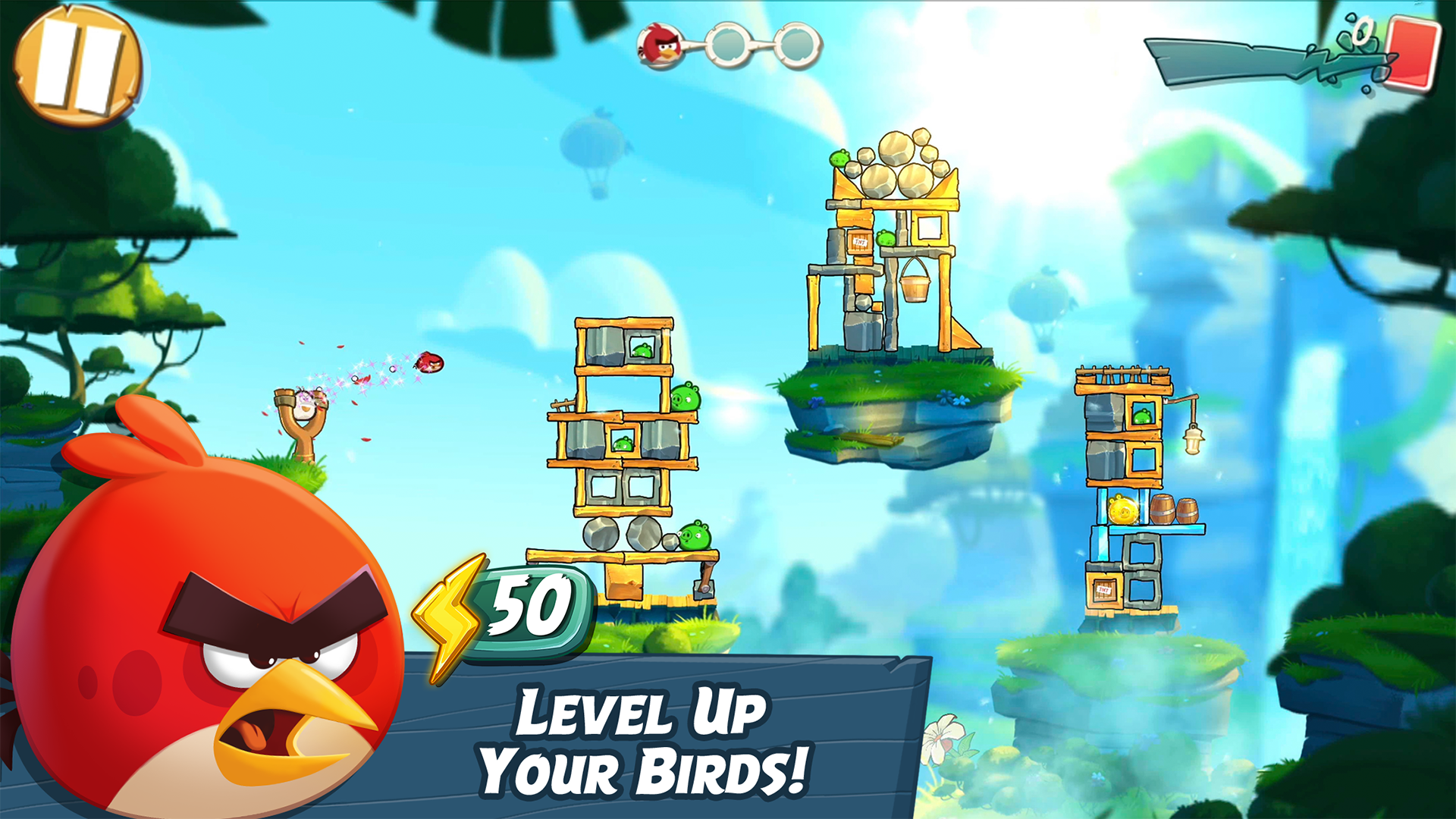
Angry Birds 2 keeps the slingshot, the pigs, the destructible scenery, and the satisfying physics that built the franchise. What it adds, and never lets you forget, is the live-service scaffolding around it. Levels are split into multi-stage chapters, you choose which bird to fling next from a hand of cards, and spells (ice block, hot chili, blizzard) drop in as consumables you have to earn or buy. There is a daily challenge, a clan system, an Arena PvP mode, and the Tower of Fortune — a roulette wheel for boosters and gems.
The economy is the actual game. You start each session with five lives. Fail a chapter and you lose one. Run out and the wait timer kicks in — roughly thirty minutes per life, or pay gems to refill. Boosters do not come from a shop; they come from gacha boxes you spin with gems or earn slowly through play. Gems themselves come from in-app purchases priced from a dollar up to roughly a hundred. The Amazon Appstore build is functionally identical to the iOS and Google Play versions — same chapters, same energy cap, same store.
Rovio still ships content updates regularly. Holiday events, themed levels, and new bird unlocks land on a predictable cadence. The art direction is genuinely good. The 3D models are crisp on a Fire tablet, the destruction physics still feel weighty, and the soundtrack is the same propulsive earworm it was in 2015.
MISSION ACCOMPLISHED
When you are actually flinging birds, this is the same game that ate the world's commute time in 2012. The slingshot pull, the trajectory arc, the moment a Chuck splits into three and clears a tower — Rovio's core mechanic remains one of the most refined feel-good loops in mobile gaming. The bird-card system is a real design improvement over the original, adding tactical decisions (which bird first, which to save) without overcomplicating the fling.
Performance on Fire tablets is solid. The game launches fast, runs at a stable framerate even on older Fire HD hardware, and the touch latency on the slingshot pull is tight enough that the physics feel honest. For an Amazon Appstore title in 2026, that is not a low bar — many ports here feel like afterthoughts. This one does not.
ROOM TO IMPROVE
The five-life cap is the single most player-hostile decision in this game, and it has been in place since launch. Lose three chapters in a row on a difficulty spike (the spikes are deliberate — see the Tower of Fortune funnel) and you are locked out for ninety minutes or asked to spend. The gacha booster system compounds it. You cannot buy a specific power-up; you spin for a chance at one. This is gambling-adjacent design, and it is wedged into a game whose original audience included a lot of children.
Sega's $200 million impairment write-down on Rovio in early 2026 was not subtle, and the response inside Angry Birds 2 has been more monetisation, not less. Ad frequency between levels has crept up. The Premium subscription pitch (no ads, refilled lives, daily gems) appears more often. The original Angry Birds was a one-dollar premium game. This one is engineered to extract roughly that much per session from anyone who keeps playing past chapter twenty.
CONCLUSION
Install this if you want a half-hour of physics nostalgia on a Fire tablet and have the discipline to close the app when the lives run out. Avoid it if you are buying it for a kid who will see the gacha wheel and the gem store before they see the pigs. The original Angry Birds is gone from the storefronts; Cut the Rope Remastered and Bad Piggies are still better-behaved alternatives in the same physics-puzzle lane.